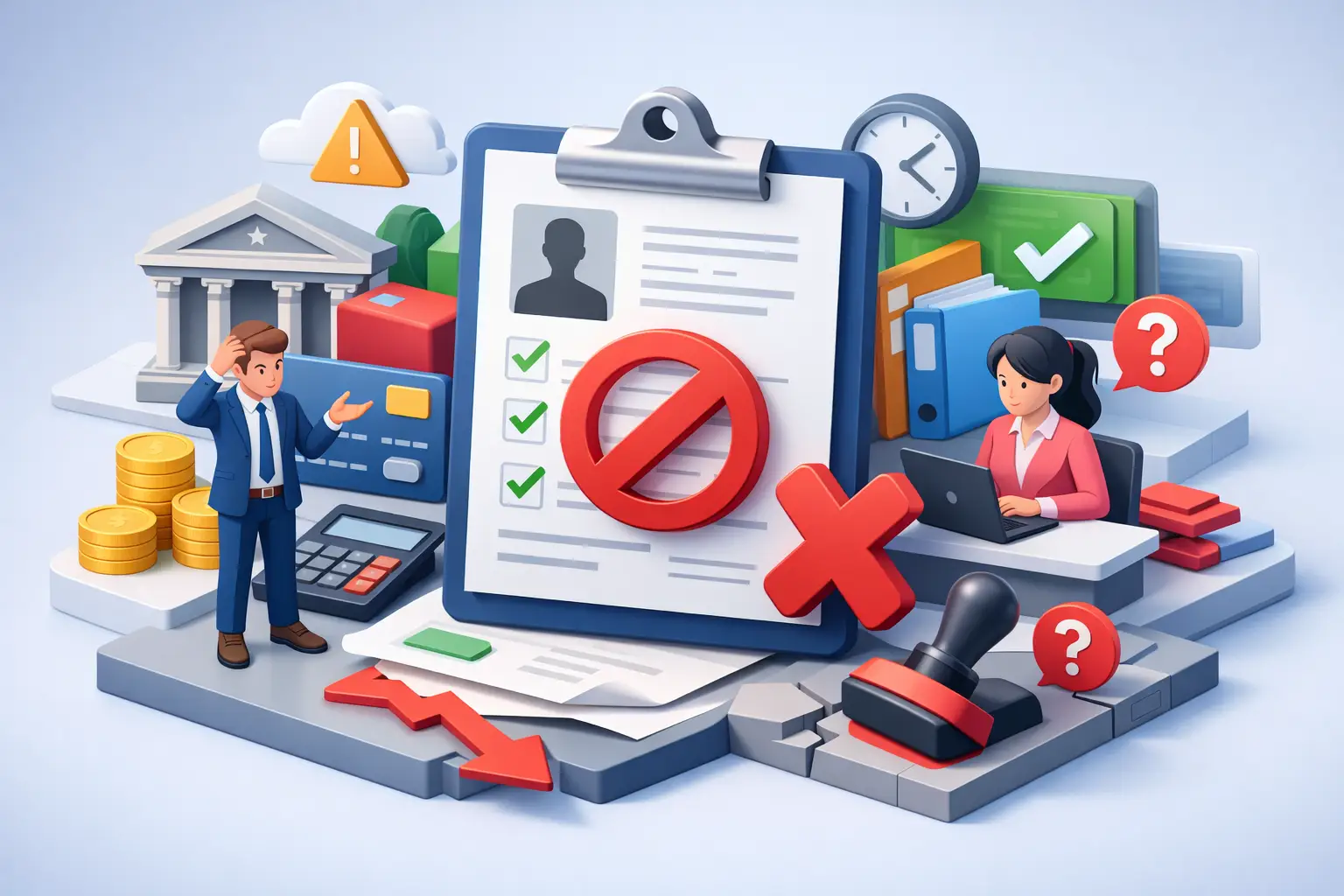

A bank rejection rarely comes with a full explanation. You submit the company documents, answer the compliance questions, wait for updates – and then get told no, or worse, get asked for more documents again and again. If you are asking, “why was business account rejected,” the answer is usually not one issue but a combination of risk, documentation, and how clearly your business profile fits the bank’s criteria.
For companies operating in the UAE, this can be especially frustrating. Founders often assume that a valid trade license should be enough to open a business account. In practice, banks apply their own internal risk frameworks, and those frameworks can be stricter than many business owners expect. Approval depends on more than registration. It depends on whether your company looks complete, transparent, and commercially credible from a banking perspective.
Why was business account rejected by the bank?
Banks do not reject applications casually. A business account creates compliance responsibilities for the bank, especially around anti-money laundering controls, source of funds verification, and ongoing transaction monitoring. If your application raises questions the bank cannot comfortably resolve, rejection becomes the safer option.
This does not always mean there is a serious problem with your company. Sometimes the business is legitimate but presented poorly. Sometimes the documents are technically correct but incomplete for the bank’s review process. In other cases, the issue is structural, such as the type of activity, ownership profile, expected transaction pattern, or a mismatch between what the company claims and what it can prove.
That is why business account approval is not just an administrative step. It is a risk assessment.
The most common reasons a business account gets rejected
One of the biggest reasons is incomplete or inconsistent documentation. Banks compare your trade license, incorporation records, shareholder details, passport copies, visa status, office documentation, invoices, contracts, and business model explanation. If those pieces do not align, the file starts to look uncertain. Even small inconsistencies, such as different addresses, unclear activity descriptions, or missing shareholder information, can slow down the review or trigger rejection.
Another common issue is the nature of the business activity. Certain industries are reviewed more strictly because they are considered higher risk. This can include sectors involving crypto-related activity, financial intermediation, general trading without a clear product trail, consulting without strong commercial evidence, or businesses dealing with jurisdictions that banks monitor closely. A legal activity can still be difficult to bank if the risk team sees limited visibility or higher compliance exposure.
Lack of business substance is another major factor. If your company is newly formed and has no website, no contracts, no invoices, no office presence, and no clear evidence of operations, the bank may question whether the business is truly active. This is a frequent issue for startups and holding structures. The business may be genuine, but if it appears thin on paper, the bank may not be convinced.
Transaction profile also matters. Banks want to understand how money will move through the account. If projected turnover looks unrealistic, if the expected countries involved are high risk, or if the company cannot clearly explain who will pay it and why, approval becomes less likely. Broad answers such as “international trading” or “consulting services worldwide” often create more questions than confidence.
Ownership structure can create complications as well. If the ultimate beneficial owner is difficult to verify, if there are multiple layers of foreign entities, or if shareholder documents are not straightforward, the bank may decide the file requires too much compliance effort. Transparency matters. The more complex the ownership, the stronger the supporting documentation must be.
Why was business account rejected even with a valid UAE license?
This is one of the most common misunderstandings in the market. A valid UAE license confirms that the company is legally registered to operate. It does not guarantee that every bank will accept the company as a client.
Banks assess commercial viability and compliance risk separately from business registration authorities. A licensing authority may approve your activity based on legal and regulatory criteria. A bank then asks a different set of questions: Can we identify the owners clearly? Does the business have a logical source of funds? Are the expected transactions consistent with the activity? Is there enough evidence to support the commercial model? Are the counterparties and jurisdictions acceptable under our internal policy?
So if you are wondering why was business account rejected despite having all your company formation documents, the answer may be that the bank wanted a more complete operating profile, not just a valid registration file.
Red flags banks pay close attention to
Banks rarely publish a full list of rejection triggers, but certain patterns come up repeatedly. A weak online presence is one of them. For many businesses, especially service companies, a professional website and business email are part of basic credibility. If your company claims to be active in the market but has no visible business profile, the bank may question the level of substance.
Another red flag is unclear source of funds. If the initial deposit is coming from a personal account, a foreign entity, or a third party without a clear explanation, that raises concern. The same applies when business owners cannot show where startup capital came from or how early revenues were generated.
Frequent changes in business activity, shareholder structure, or jurisdictional setup can also make banks cautious. Change is not automatically negative, but too many moving parts in a short period can make the company look unstable or difficult to assess.
Then there is the interview itself. Some banks ask direct questions about suppliers, clients, monthly turnover, countries of operation, and expected transaction values. Vague or inconsistent answers can damage the application, even when the documents look acceptable. The review is not just about paperwork. It is also about whether the business owner presents a clear, credible story.
What to do after a rejection
A rejection should not push you into submitting the same file to another bank without changes. That usually leads to more delays and more frustration. The better approach is to diagnose the problem before applying again.
Start by reviewing the full application pack. Check whether your documents are current, consistent, and complete. Make sure your trade license activity matches what the business actually does. Confirm that shareholder records, addresses, and identity documents are aligned across all paperwork. If your company is operational, gather evidence such as invoices, contracts, supplier agreements, lease documents, and proof of business activity.
Next, strengthen the commercial profile. A clear website, a business email domain, a concise company profile, and realistic financial projections can make a meaningful difference. These details help the bank understand that the company is organized and prepared for a formal banking relationship.
It is also important to reconsider bank fit. Not every bank is suitable for every company. Some banks are more comfortable with startups, some prefer established trading businesses, and some are stricter on certain sectors or ownership structures. Reapplying to the wrong bank wastes time. A targeted application is usually more effective than a broad one.
How to improve your approval chances
The strongest applications are the ones that remove doubt. That means presenting a business that is easy to verify, easy to understand, and supported by evidence.
Be specific about your activity. Instead of saying you provide “general consultancy,” explain the exact service, who your clients are, where they are based, and how payments will be received. Instead of saying you do “trading,” identify the products, supplier countries, buyer profile, and expected shipment or invoicing pattern.
Keep your financial story realistic. Overstated turnover projections can hurt credibility just as much as missing financial information. Banks understand that new businesses may start small. What they want is a logical plan backed by documents and a consistent explanation.
If your structure is more complex, address that directly rather than hoping it will be overlooked. Provide beneficial ownership documents, group structure charts, and source of wealth support where relevant. Clarity reduces compliance hesitation.
For many businesses, professional guidance is the difference between a weak submission and a bank-ready file. A consultancy that understands both company setup and banking expectations can help position the application correctly from the start. That matters because account opening is not only about collecting documents. It is about presenting the right case to the right institution.
At My Eloah, we often see clients come to us after an initial rejection, believing the issue was simply bad luck. More often, the real problem is that the application was not structured in the way banks expect. Once the business profile is clarified and the supporting documents are organized properly, the outcome can change significantly.
A rejected application is not always a dead end. It is usually a signal that the bank needs more clarity, more substance, or a better-aligned risk profile. The next step is not to guess. It is to prepare smarter, present stronger, and approach the process with the same discipline you bring to building the business itself.