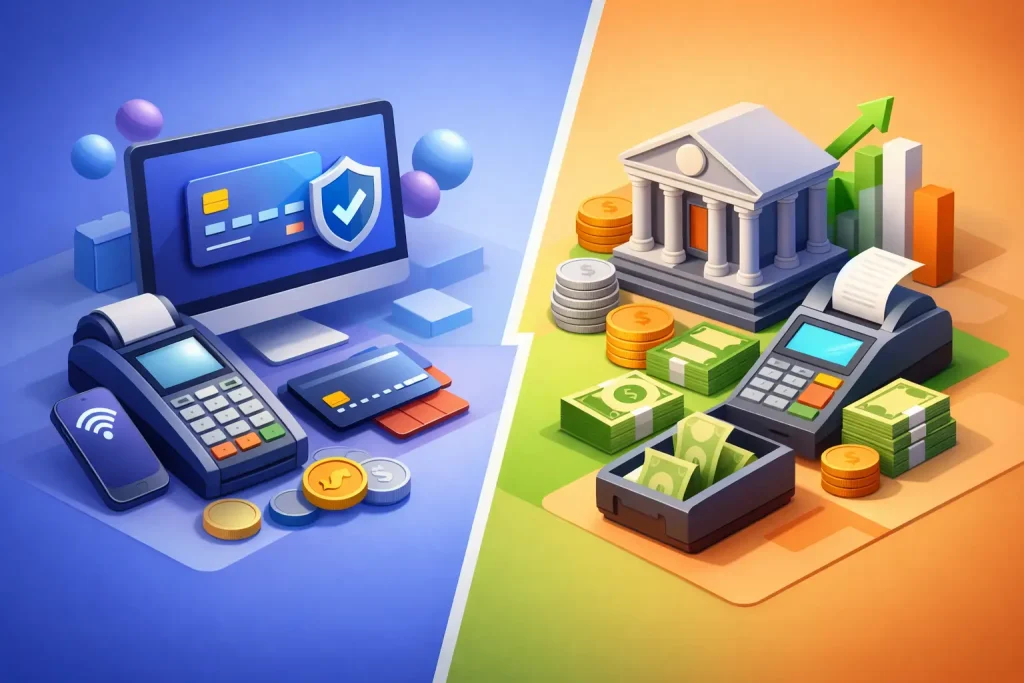
If you are setting up online payments for a UAE business, the payment gateway vs merchant account question usually appears right after you choose your bank and build your website. It is one of the most common points of confusion for founders because both are involved in accepting card payments, but they do very different jobs.
Getting this right matters early. Choose the wrong setup, and you can run into approval delays, failed transactions, cash flow issues, or a payment system that does not fit your sales model. Choose the right one, and you create a cleaner path for revenue collection, customer trust, and day-to-day operations.
Payment gateway vs merchant account: the core difference
A payment gateway is the technology layer that securely captures and sends payment data between your customer, your website, the payment processor, and the bank. It is the checkout infrastructure. When a customer enters card details online, the gateway encrypts that information and passes it through the payment chain for authorization.
A merchant account is a business account specifically used to hold card payment funds before they are settled into your main business bank account. It is not the same as your regular operating account. Think of it as the temporary holding point for card transactions while the payment is approved, processed, and prepared for payout.
In simple terms, the gateway handles the transaction flow, while the merchant account handles the money flow.
That distinction sounds straightforward, but in practice the lines can blur because many payment providers now bundle these services together. That is why business owners often assume they are buying one product when they may actually be buying a package of several payment services under one provider.
How payment gateways and merchant accounts work together
When a customer places an order on your website, the payment gateway collects the card details and sends them securely for authorization. The issuing bank checks whether the card is valid and whether funds are available. If the transaction is approved, the payment moves through processing channels and the funds are directed to the merchant account. After that, the money is settled into your business bank account based on the provider’s payout schedule.
So while the gateway and merchant account are separate functions, they often operate as part of the same transaction journey. One cannot replace the other if you are building a traditional card acceptance setup from scratch.
This is also where business owners need to pay attention to the full stack. Online payments may involve a payment gateway, merchant account, acquiring bank, processor, fraud screening tools, chargeback controls, and settlement rules. If one part is weak or poorly matched to your business, the customer still feels the friction at checkout.
Why the difference matters for UAE businesses
In the UAE, payment setup is not only a technical decision. It is also a banking, compliance, and operational decision. Providers and banks will often assess your trade license, business activity, expected transaction volume, website readiness, refund policy, and in some cases your corporate structure or source of funds.
This is why the payment gateway vs merchant account conversation should not happen in isolation. Founders often focus on website checkout first, then realize later that approval for card acceptance depends on documentation, business activity classification, and the strength of the company setup behind it.
For example, a low-risk trading company with a clear online store may have a smoother path than a business with unclear service terms, cross-border complexity, or a business bank account still in progress. If your payment infrastructure is not aligned with your company structure, delays are common.
Do you always need both?
Not always in the way people assume.
Traditionally, yes – you needed a payment gateway and a merchant account as separate components. Today, many modern payment service providers offer an all-in-one model. In that setup, the provider supplies the gateway technology and also gives you access to merchant account functionality under its platform.
This can be a good fit for startups and growing businesses because it simplifies onboarding, reporting, and technical integration. Instead of coordinating multiple vendors, you work with one provider for checkout, transaction handling, and settlement.
However, convenience comes with trade-offs. Bundled providers may charge higher transaction fees, hold reserves, impose stricter payout controls, or limit flexibility if your business model changes. A dedicated merchant account arrangement through a bank or acquiring partner may offer better long-term economics for some companies, especially those with steady volume and lower risk profiles.
The right choice depends on your stage, transaction volume, risk category, and need for control.
Payment gateway vs merchant account for different business stages
If you are a startup launching a new online business, speed and simplicity often matter most. In that case, an all-in-one provider can make sense because you can begin accepting payments without building a complex financial setup. The main priority is getting live with a reliable checkout experience and clear settlement terms.
If you are an established business processing higher monthly volume, the economics deserve a closer look. Separate merchant account arrangements can sometimes produce lower effective costs, better negotiation leverage, and stronger banking relationships. That matters when payment acceptance becomes a core part of your revenue engine rather than a basic operational need.
If you operate in a higher-risk category, the decision becomes even more nuanced. Approval standards, rolling reserves, dispute management, and fund hold periods can vary significantly between providers. In those cases, the cheapest advertised option is rarely the most practical one.
What to evaluate before choosing a setup
Business owners often compare payment providers based only on transaction fees. That is too narrow.
You should also look at approval requirements, integration with your website or ecommerce platform, settlement timing, refund handling, chargeback support, currency capabilities, and whether the provider is a strong fit for your specific business activity. A fast onboarding promise means little if payouts are unpredictable or if the provider is not comfortable with your business model.
It is also worth reviewing customer experience. A payment gateway that adds friction at checkout can reduce conversions even if the back-end cost looks attractive. Mobile usability, page speed, card acceptance options, and trust signals all affect revenue.
Then there is the banking side. A merchant account setup should support stable cash flow, not create uncertainty. If your business depends on predictable receivables to manage inventory, payroll, or marketing spend, settlement reliability matters as much as processing approval.
Common mistakes business owners make
One common mistake is assuming a payment gateway means the money goes directly into a regular business account with no additional structure involved. In many cases, there is still a merchant account function in the background, even if the provider has simplified the experience.
Another mistake is choosing based on convenience alone. A provider that is easy to start with may not be the right fit six months later when transaction volume grows, subscription billing becomes necessary, or cross-border payments increase.
A third issue is treating payment setup as a standalone tech purchase. It is not. It connects to your licensing, banking, compliance, website readiness, and customer terms. If any of those pieces are weak, payment approval or account stability can suffer.
This is why businesses entering or expanding in the UAE often benefit from handling payment setup as part of a wider operational plan rather than as an isolated website task.
A practical way to decide
Start with your business model. Are you selling products, services, subscriptions, bookings, or custom invoices? Then assess your expected transaction volume, average order value, customer geography, and whether you need recurring billing or multi-currency acceptance.
From there, determine whether your priority is speed, flexibility, lower long-term cost, or tighter control. If you are early-stage and need a fast launch, a bundled solution may be the efficient path. If you are scaling and want stronger financial structure, a dedicated merchant account arrangement may be worth pursuing.
Most importantly, make sure the payment setup matches the business entity behind it. Your legal structure, bank account readiness, supporting documents, and website compliance all influence how smoothly payment onboarding will go. This is where a practical advisory partner can reduce friction by aligning business setup, banking, and operational requirements before problems appear. For businesses building in the UAE, My Eloah often sees that the strongest payment outcomes come from good preparation rather than last-minute fixes.
A payment gateway helps you accept payments. A merchant account helps you receive them properly. When those two pieces are matched to your business stage and structure, your payment system becomes more than a checkout tool – it becomes a reliable part of growth.