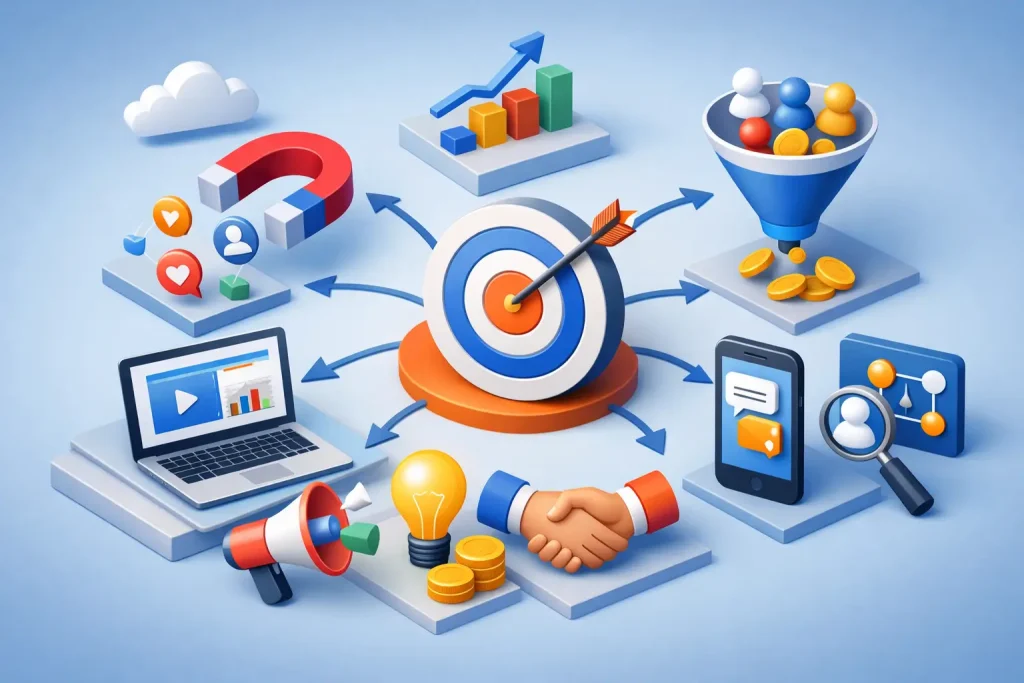
A business can spend months refining its offer and still struggle to grow because the wrong people are seeing it – or the right people are seeing it in the wrong place. Choosing the best lead generation channels is not about being everywhere. It is about identifying where qualified prospects already spend time, how they evaluate providers, and what level of trust they need before they take action.
For businesses operating in the UAE, that decision matters even more. Many companies are selling services that involve financial commitments, compliance considerations, long sales cycles, or a strong need for credibility. In those cases, lead generation works best when the channel matches the buying behavior of the audience, not when it simply produces the highest volume.
What makes the best lead generation channels effective
The best-performing channels usually share three qualities. First, they attract people with clear commercial intent. Second, they allow your business to communicate trust quickly. Third, they create a repeatable path from first contact to qualified conversation.
That is why there is no universal winner. A company offering low-cost impulse products may thrive on social media alone. A consultancy, lender, or business services firm will usually need channels that support education, credibility, and follow-up. If your sales process involves consultation, documentation, or multiple decision-makers, quality matters more than raw lead count.
1. Organic search remains one of the best lead generation channels
When someone searches for a solution, the timing is hard to beat. Organic search attracts prospects who are actively looking for answers, providers, or pricing. That makes it one of the best lead generation channels for businesses that solve clear operational problems.
For example, a founder searching for help with company formation, VAT support, or business account opening is already moving toward a decision. If your site answers the exact question they have, your lead is warmer before the first conversation even begins.
The trade-off is speed. Search engine visibility takes time, consistent content, technical site health, and strong service pages. It is not the right channel if you need immediate lead flow next week. It is the right channel if you want durable lead generation that does not disappear the moment ad spend pauses.
2. Google Ads captures high-intent demand quickly
Paid search works well when prospects know what they need and are ready to speak with a provider. It gives businesses immediate visibility for commercial terms and allows tighter control over geography, budget, and messaging.
For service-based companies, this can be especially useful when targeting urgent needs. Someone searching for tax filing support or a business setup consultant is usually not browsing casually. They often want a direct path to consultation.
Still, paid search can become expensive if your targeting is too broad or your landing pages are weak. Many businesses blame the channel when the real issue is poor conversion structure. If the ad promise, page content, and follow-up process do not align, you pay for clicks that never turn into revenue.
3. LinkedIn is strong for B2B relationship-driven sales
If your audience includes founders, executives, finance leaders, or operations teams, LinkedIn deserves serious attention. It is one of the most effective channels for B2B services where trust, expertise, and relevance matter more than entertainment.
LinkedIn works in two different ways. It can support inbound lead generation through thought leadership, company updates, and educational content. It can also support outbound prospecting through targeted outreach to decision-makers. For many firms, the strongest results come from combining both approaches.
The limitation is that LinkedIn rarely rewards generic messaging. Prospects ignore vague offers and sales-heavy posts. To generate qualified leads, your messaging needs to reflect actual business pain points, such as market entry challenges, banking delays, tax compliance concerns, or growth planning.
4. Referral partnerships produce higher-trust leads
Some of the best leads come through trusted introductions. Referral channels often convert better because the credibility transfer has already happened before the first meeting.
In practice, this might include accountants, legal advisors, industry consultants, real estate firms, or complementary agencies that serve the same client base. For UAE-focused businesses, partnership networks can be especially valuable because many clients need multiple services at the same time – setup, compliance, banking, digital presence, and financing often overlap.
The challenge is that referral partnerships do not scale automatically. They require relationship management, clear positioning, and a reliable service experience. If partners are not confident that you will deliver well, the referrals stop. This channel rewards consistency more than promotion.
5. Email marketing is still one of the best lead generation channels for nurturing
Email rarely gets enough credit because it is often judged only by open rates. In reality, it is one of the best lead generation channels for moving interested prospects toward a decision, especially when services involve education and timing.
Many leads are not ready to engage immediately. They may be comparing providers, waiting on internal approvals, or planning a market entry several months ahead. Email keeps your business present during that consideration period.
This only works if the communication is useful. A steady flow of promotional emails will not build trust. Practical guidance, updates on regulatory changes, decision-making checklists, and clear next steps are far more effective. Good email marketing supports the sales process without forcing it.
6. Webinars and educational events build authority
When a service requires explanation, educational formats can perform extremely well. Webinars, workshops, and focused online events help businesses demonstrate expertise while qualifying interest in real time.
This is particularly effective for topics where prospects have risk exposure. Tax compliance, company formation, funding readiness, and digital growth planning all benefit from explanation. When prospects see that your team understands both strategy and execution, they become more willing to start a conversation.
The trade-off is effort. Events take planning, promotion, and strong follow-up. Attendance alone is not success. The real value comes from what happens after the session – booked consultations, tailored next steps, and continued engagement with attendees who are not ready yet.
7. Social media can work, but only with the right expectation
Social media is often treated as a default lead generation engine. In reality, its value depends heavily on your audience, offer, and sales cycle. For high-trust services, social platforms are often better at supporting brand familiarity than driving immediate qualified conversions.
That does not make them unimportant. A consistent presence helps validate your business when prospects research you after finding you elsewhere. It also creates opportunities to distribute insights, client-focused updates, and proof of activity in the market.
The mistake is expecting every platform to produce direct leads. Instagram may help brand visibility. LinkedIn may support B2B demand. Short-form content may increase awareness. But if your offer requires consultation and trust, social usually works best as part of a wider channel mix rather than as a standalone source.
8. Direct outreach works when it is precise and relevant
Outbound lead generation still has a place, especially when you know exactly which businesses fit your ideal client profile. Targeted outreach by email, phone, or LinkedIn can open doors that inbound marketing may take months to reach.
This works best when your targeting is narrow and your message is informed. A generic pitch sent to hundreds of companies damages brand perception. A well-researched message tied to a specific business need can start meaningful conversations.
For companies serving a defined region or sector, direct outreach can be highly efficient. It is especially useful when your service solves a clear problem but the prospect may not yet be searching for a provider. The key is to lead with relevance, not volume.
How to choose the best lead generation channels for your business
Start with your sales reality, not marketing trends. If your service has a short buying cycle and clear search demand, search and paid ads may deserve priority. If trust and relationship depth matter most, referrals, LinkedIn, and email nurturing may produce better outcomes.
You should also look at operational readiness. Some channels create more leads than your team can handle well. Others produce fewer leads but much stronger conversion rates. There is no advantage in generating interest if your follow-up is slow, your consultation process is unclear, or your website does not support decision-making.
A practical approach is to prioritize two primary channels and one supporting channel. That keeps execution focused. A consultancy firm, for example, might pair organic search with LinkedIn and use email to nurture inquiries over time. A business with urgent service demand may combine Google Ads with strong landing pages and a disciplined sales response process.
At My Eloah, this is often where businesses need the most guidance – not just choosing a channel, but aligning lead generation with operations, credibility, and growth goals.
Measure lead quality, not just lead volume
The final test is simple. Which channels produce qualified conversations, faster decisions, and stronger client value over time? A high lead count can look promising while hiding poor fit, low trust, or wasted sales effort.
Track where real clients come from, how long they take to convert, and which channels lead to stronger retention or larger engagements. That data will tell you more than vanity metrics ever will.
The best lead generation strategy is usually not the loudest one. It is the one your market trusts, your team can execute well, and your business can sustain as you grow.