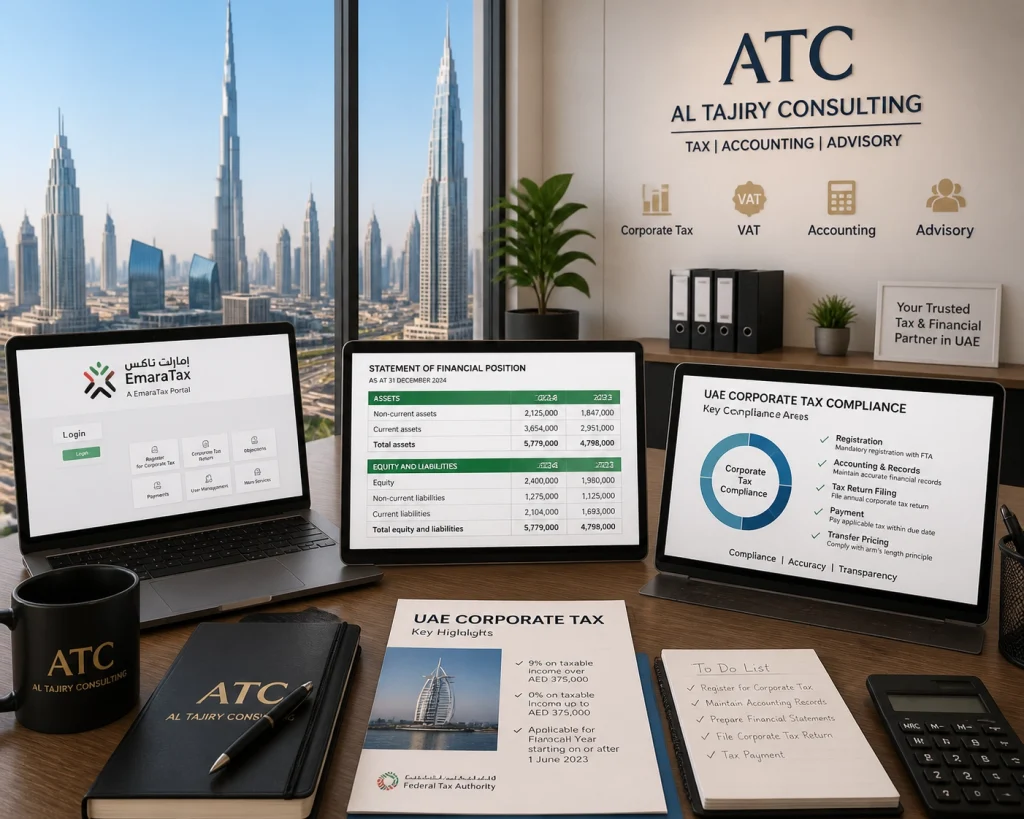
As the regulatory landscape across the United Arab Emirates continues to mature, navigating federal mandates has become a critical operational priority for every enterprise operating within the country. For businesses with a financial year ending on December 31, 2025, the Federal Tax Authority (FTA) has established a strict and unyielding statutory deadline: September 30, 2026. By this date, eligible entities must complete both their corporate tax return filing and settle any outstanding tax liabilities.
At my eloah business hub, we recognize that transitioning into the UAE’s corporate tax regime requires precision, foresight, and rigorous accounting standards. Whether you established your enterprise through our comprehensive company formation UAE solutions or are managing an established commercial entity, understanding the nuances of this federal filing cycle is essential to protecting your corporate standing. Failing to meet this deadline or misinterpreting statutory obligations can result in severe financial penalties and operational friction, including complications when dealing with your business bank account UAE reviews.
In this comprehensive guide, we examine the critical steps, statutory thresholds, relief mechanisms, and compliance best practices required to ensure your business navigates the September 30, 2026 deadline seamlessly.
How to Understand the September 30, 2026 Corporate Tax Filing Deadline
The introduction of Federal Decree-Law No. 47 of 2022 on the Taxation of Corporations and Businesses marked a historic shift in the UAE economy. Under Article 53 of the law, taxable persons are mandated to file their corporate tax return and pay any corresponding tax due within nine months from the end of the relevant tax period.
For companies operating on a standard calendar financial year: meaning their financial period concluded on December 31, 2025: the nine-month statutory window culminates on September 30, 2026. It is vital for business owners and chief financial officers to note that filing and payment share the exact same deadline. There are no routine extensions or staggered grace periods provided by the FTA.
Furthermore, corporate tax compliance is deeply intertwined with broader financial governance. Modern commercial banks in the UAE routinely request filed corporate tax returns during annual KYC (Know Your Customer) reviews and credit evaluations. Businesses seeking expansion capital or a business loan UAE must provide verified, FTA-compliant financial statements. Establishing an immaculate compliance record now safeguards your banking relationships and secures long-term financial viability.

How to Determine Your Eligibility for Small Business Relief
One of the most common misconceptions among emerging enterprises and small-to-medium-sized businesses is that falling under specific revenue thresholds exempts them entirely from regulatory filings. Under Ministerial Decision No. 73 of 2023, the UAE government introduced Small Business Relief to support startups and smaller operators.
To qualify for Small Business Relief for the relevant tax period, a resident taxable person must meet two strict criteria:
- Revenue Threshold: Their revenue for the relevant tax period and previous tax periods must not exceed AED 3 million per tax period.
- Exclusions: The relief is generally not available to Qualifying Free Zone Persons or multinational enterprises that meet specific global revenue thresholds under Pillar Two rules.
However, business owners must understand a critical distinction: eligibility for Small Business Relief means you are treated as having no taxable income, but it does NOT exempt you from the obligation to file a corporate tax return. Every registered business must submit a simplified tax return through the official portal to claim the relief. Failing to file simply because your revenue is low will trigger unnecessary administrative penalties.
Our advisors at my eloah business hub specialize in evaluating financial ledgers to confirm relief eligibility, ensuring that your enterprise benefits from every statutory concession available under our vat corporate tax advisory framework.
How to Register for Corporate Tax and File Through EmaraTax
The entire UAE corporate tax lifecycle: from initial registration to final return submission: is conducted electronically via the FTA’s dedicated digital portal, EmaraTax. Navigating this platform requires precise data entry, accurate accounting classifications, and secure digital authentication.
The step-by-step digital filing process involves the following critical phases:
- Account Access and Authentication: Log into your corporate EmaraTax profile using authorized credentials. Ensure that your user profile and primary user permissions are up to date.
- Reviewing Tax Registration Data: Verify that your Tax Registration Number (TRN), trade license details, and financial year-end dates match official government records.
- Preparing Financial Statements: Upload or input financial data derived from audited or meticulously maintained financial statements prepared in accordance with International Financial Reporting Standards (IFRS).
- Completing the Tax Return Form: Accurately report your net accounting income, make statutory adjustments (such as disallowed expenses, exempt income, and qualifying relief deductions), and calculate your taxable income.
- Submitting and Settling Payments: Once the return is validated, submit the form and arrange for immediate electronic settlement of any corporate tax due through approved payment channels.
Because even minor clerical errors or mismatched financial figures can trigger automated audits or queries from the FTA, partnering with an experienced business consultancy Dubai firm ensures absolute accuracy during every stage of the digital filing process.

How to Avoid Common Penalties for Late Filing or Payment
The Federal Tax Authority enforces strict administrative penalties to ensure compliance across the commercial ecosystem. Ignoring deadlines or submitting incomplete documentation can severely impact your bottom line. Understanding the penalty structure provides a strong incentive for timely action:
- Late Filing Penalties: If a taxable person fails to file their corporate tax return by September 30, 2026, the FTA imposes a penalty of AED 500 per month for the first 12 months, increasing to AED 1,000 per month for each subsequent month or part thereof.
- Late Payment Penalties: Any corporate tax liability that remains unpaid after the statutory deadline incurs a late payment penalty calculated at a rate of 14% per annum, charged on the unpaid tax amount.
Beyond monetary fines, persistent non-compliance can lead to administrative freezes on commercial activities, difficulties in renewing trade licenses, and heightened scrutiny from commercial banks. Maintaining proactive communication with tax authorities and working alongside professional consultants shields your enterprise from avoidable financial friction.
How to Prepare Your Financial Records for a Smooth Filing Process
Preparing for the September 30 deadline requires more than just filling out an online form; it demands a rigorous audit of your bookkeeping practices. To eliminate stress and ensure absolute compliance, businesses should execute the following preparatory measures:
- Reconcile All Bank Accounts: Ensure that every transaction across your commercial accounts is fully reconciled against invoices, receipts, and ledger entries. Discrepancies between bank statements and accounting records are primary triggers for tax audits.
- Review Expense Categorization: Verify that business expenses are properly substantiated with valid tax invoices and adhere to FTA deductibility rules (e.g., entertainment expenses are typically subject to a 50% restriction).
- Coordinate with VAT Records: Ensure that your corporate tax financial figures align harmoniously with your previously submitted quarterly or monthly VAT returns. Inconsistencies between VAT turnover and corporate tax revenue figures will immediately flag your file for review.
- Maintain Statutory Record Retention: Under UAE tax law, businesses are required to maintain all financial records, invoices, and accounting books for a minimum of seven years following the end of the tax period.
By instituting these rigorous internal controls, your organization transforms tax season from an administrative burden into a streamlined administrative routine.

How to Get Expert Support for Your UAE Tax Compliance
As the September 30, 2026 deadline approaches, waiting until the final weeks to compile financial data introduces immense operational risk. System congestion on the EmaraTax portal, unexpected accounting adjustments, and complex relief calculations demand professional oversight.
At my eloah business hub, we provide end-to-end advisory services designed to protect your enterprise. From initial tax registration and bookkeeping oversight to precise EmaraTax return filing and strategic tax planning, our experienced professionals act as your dedicated compliance partner. Whether you are scaling an existing enterprise or managing regulatory obligations for a newly formed entity, our tailored approach ensures complete peace of mind.
Book a free consultation : https://wa.me/971504036424 | WhatsApp: +971 50 403 6424