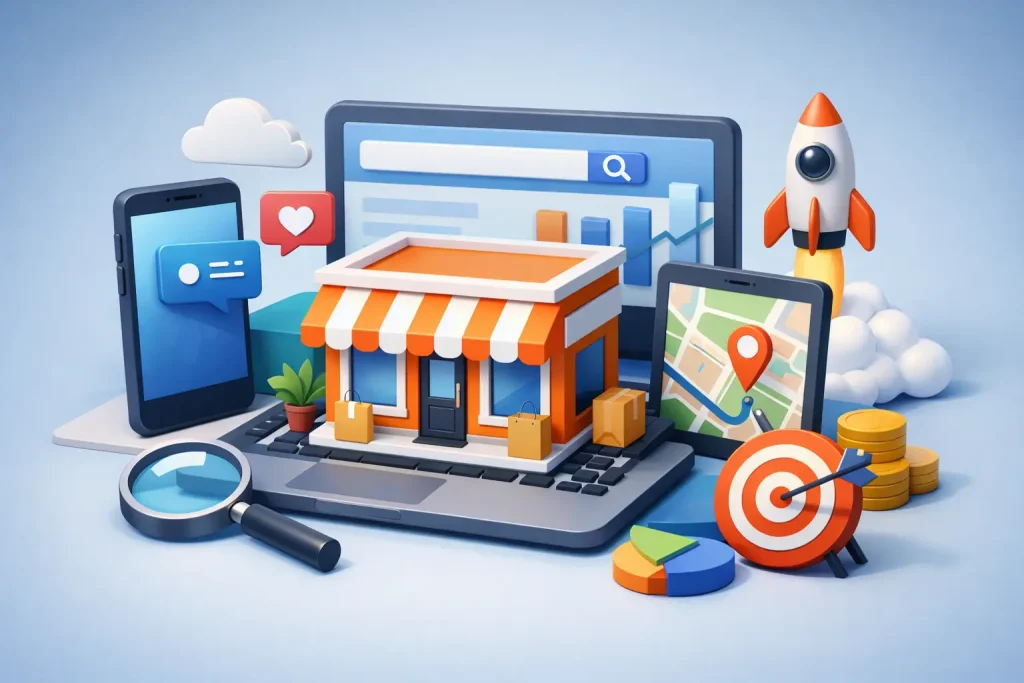
A customer hears about your business, searches your name, and lands on a page that looks outdated, incomplete, or hard to trust. That moment costs more than a click. It can delay a sale, weaken credibility, and make a serious business look unprepared. This small business digital presence guide is built for founders and growing companies that need their online presence to support real commercial goals, not just exist.
For businesses operating in the UAE, the stakes are even higher. Buyers, partners, lenders, and suppliers often assess a company online before they respond to a proposal or agree to a meeting. A digital presence is no longer limited to a website. It includes how your business appears in search, how clearly your services are explained, how consistently your brand is presented, and whether your online assets reflect a company that is organized, compliant, and ready to do business.
What a strong digital presence actually means
A strong digital presence is not about being active on every platform. It is about making it easy for the right people to find you, understand what you offer, and trust your business enough to take the next step.
For most small businesses, that starts with three essentials. First, your website needs to communicate clearly and load properly on mobile. Second, your business information must be consistent across search and directory listings. Third, your marketing should support a specific objective, whether that is lead generation, sales inquiries, bookings, or brand credibility.
Many companies invest too early in volume-based marketing without fixing the basics. They run ads to a weak website, post regularly on social media without a clear offer, or focus on visual design while neglecting structure and content. The result is activity without traction.
Start with business goals, not marketing channels
Before you choose tactics, define what your digital presence needs to do for the business. A startup entering the UAE market may need immediate credibility and a professional website that supports bank account opening, investor conversations, and early customer trust. An established company may need stronger local visibility and better lead capture. A service business may need qualified inquiries more than broad brand awareness.
This is where many digital plans go off track. The right setup depends on your stage, industry, sales cycle, and operating model. A B2B consultancy and an e-commerce brand should not have the same digital priorities. Neither should a new mainland company and a mature business expanding into new emirates.
When goals are clear, decisions become easier. You can identify what matters now, what can wait, and where budget will have the highest return.
The core assets in a small business digital presence guide
Your website is the center of your digital presence, but it should not carry the entire burden alone. Each asset has a role, and they need to work together.
Website
A business website should answer basic commercial questions quickly. Who are you, what do you offer, who is it for, and how can someone contact you? If a visitor has to search for this information, the site is underperforming.
A strong small business website also reflects operational maturity. Clear service pages, working forms, accurate business details, and a professional layout all signal reliability. For UAE businesses, this matters when dealing with customers who are comparing multiple providers and making decisions quickly.
Search visibility
Search visibility is what helps your business appear when someone looks for your company name, services, or local solutions. If your business cannot be found easily, stronger competitors will capture attention first.
This does not always require aggressive SEO from day one. In many cases, the immediate priority is making sure your business name, descriptions, contact details, and service content are accurate and aligned. Over time, search strategy can expand into location-focused pages, educational content, and keyword targeting based on buyer intent.
Business profiles and listings
Your digital presence also includes all the places where your company information appears outside your website. If your phone number, address, email, or business description differs across platforms, it creates friction and weakens trust.
Consistency matters because customers use these signals to confirm legitimacy. Search engines do the same. For smaller businesses, accurate listings can improve visibility and support local discovery without major advertising spend.
Content and messaging
Content is not just blog writing. It includes the words on your homepage, service pages, social profiles, ads, and forms. Good messaging reduces hesitation. It shows people that you understand their needs and can deliver a specific result.
The strongest messaging is usually straightforward. It explains the problem, the service, the outcome, and the next step. It does not rely on vague claims or technical language that hides the value.
Common mistakes that weaken online credibility
A digital presence often fails for practical reasons, not dramatic ones. The website may look fine but lack clear calls to action. Service pages may be too thin to explain value. Branding may be inconsistent from one platform to another. Or the business may be active online without a defined process for converting inquiries into clients.
Another common issue is trying to scale visibility before the operating side is ready. If lead generation improves but your follow-up is slow, your forms are unreliable, or your service presentation is unclear, the business absorbs cost without creating momentum.
For regulated and growth-focused markets like the UAE, credibility gaps can be expensive. A prospect who is uncertain about your professionalism may not ask follow-up questions. They may simply move on.
Building the right foundation in the right order
The best digital strategies are phased. That does not mean slow. It means organized.
Start with your business identity and positioning. Your online presence should reflect what kind of company you are, who you serve, and how you are different. Then build a website that supports those messages with clean structure, relevant pages, and clear inquiry paths.
After that, address search presence and listings. Make sure the business appears consistently and professionally wherever prospects may verify it. Then invest in content and campaigns that match your actual commercial priorities.
This order matters because each stage supports the next one. Marketing performs better when the website is strong. Search improves when content is clear. Conversion improves when messaging and operations are aligned.
Where small businesses should spend carefully
Not every business needs heavy investment across every channel. For some companies, a well-built website and local search visibility will deliver far better results than broad social media activity. For others, paid campaigns may make sense once service positioning and conversion pathways are proven.
The trade-off usually comes down to speed versus foundation. Paid ads can generate attention quickly, but they can also waste budget if the website and offer are weak. Organic growth is more durable, but it takes time. The right balance depends on urgency, budget, and the maturity of your sales process.
This is why a consultative approach matters. A small business does not just need digital activity. It needs the right sequence of execution, supported by commercial logic.
Why integration matters more than isolated services
One of the biggest challenges for founders is fragmentation. Website design sits with one vendor, compliance with another, banking support with someone else, and marketing with a separate agency. That arrangement often creates delays, conflicting advice, and disconnected execution.
A more effective approach is to treat digital presence as part of the broader business infrastructure. Your website should support credibility for customers and business partners. Your messaging should reflect your operational readiness. Your online visibility should align with how the business is structured and where it wants to grow.
That is especially relevant in the UAE, where formation, financial setup, compliance, and growth are often closely linked. Businesses benefit when digital planning is not isolated from the realities of launch, expansion, and administration. Firms such as My Eloah are built around this integrated model because business growth rarely happens in separate departments.
A practical standard for judging your current presence
If you want to assess your current position, ask a simple question. When someone discovers your business online, do they feel confident moving forward?
Confidence usually comes from a few visible signals. Your website looks current and credible. Your services are easy to understand. Your contact options are clear. Your business information is consistent. Your brand presentation feels organized. And your digital channels point toward a clear next step.
If any of those pieces are weak, improvement does not need to be complicated. It needs to be structured. In most cases, measurable gains come from tightening the fundamentals before expanding the strategy.
A strong digital presence should make business easier. It should shorten trust-building, support conversations, and help your company present itself with the same professionalism it brings to operations. When that alignment is in place, your online presence stops being a task on the list and starts working as a real business asset.
The right digital presence is not the loudest one. It is the one that makes your business easier to trust, easier to understand, and easier to choose.